
Run your hand across a burnished marmorino panel. Feel that faint warmth — the calcite holds heat the way a sun-facing stone wall does. Now slide your fingers onto the microcement slab sitting right beside it on the sample board. Cooler. Matte. A dry, almost tactile grip that reads industrial even when it’s bone white. That five-second touch test tells you more than an hour of scrolling Instagram ever could. I’ve watched condo owners make up their minds in that exact moment, standing in their own living room with afternoon light coming in off the lake.
This post is for anyone caught between the two finishes. Both are beautiful. Both are serious commitments. They’re not interchangeable, and the decision deserves more than a mood board.
Why the accent wall question keeps coming up in Toronto condos
Toronto’s condo market keeps pushing unit sizes down while pushing ceiling heights up and window-to-floor ratios higher than ever. You end up with a long, bright rectangular space where the developer’s drywall finish — that flat, featureless white — looks especially hollow. One accent wall becomes the whole conversation. It’s the first thing you see from the front door. It anchors the couch. It either makes the space feel like a curated home or like a temporary rental.
At the same time, Instagram and Pinterest have made both venetian plaster and microcement genuinely mainstream. People arrive at consultations with screenshots saved, but the screenshots flatten everything. Depth, sheen, temperature, the way the surface moves under a dimmer — none of that translates through a screen. What I keep hearing is: I’ve seen both, I love both, I have no idea how to choose.
That’s the question this post answers.
What venetian plaster actually feels like — and what it does to light
Venetian plaster is a lime-based finish. The traditional material is marmorino — marble dust and slaked lime mixed into a paste, applied in multiple thin coats, then burnished with a steel trowel while the surface is still partially uncured. The burnishing compresses the surface and brings up a polish that ranges from a soft satin to something close to a wet stone.
[PHOTO:1Yxdl6cE4D6WfQG0640GlZZQYn6tFEwH]
What it does to light is the whole point. A properly applied marmorino wall doesn’t reflect light the way paint does — uniformly, flatly, bouncing the same value back at you from every angle. It diffuses it. The calcite crystals in the marble dust scatter light at slightly different depths depending on how the trowel moved across the surface. Rake a lamp across it at a low angle and it seems to glow from inside. Move to the other side of the room and the same wall looks almost matte.
Tactilely, venetian plaster is smooth but not cold. There’s a slight give to it, a density that reads organic. You can feel the trowel marks if the applicator intended them, or the surface can be worked so flat that the only thing left is depth.
On a condo accent wall — say the full-width wall behind a sofa — this material adds visual mass without adding visual noise. It commands the room quietly.
[PHOTO:1PDHWFEbV7dhgkTn-0JdcWzGP5xTN0G-P]
What microcement brings to the table (and the floor, and the bathroom)
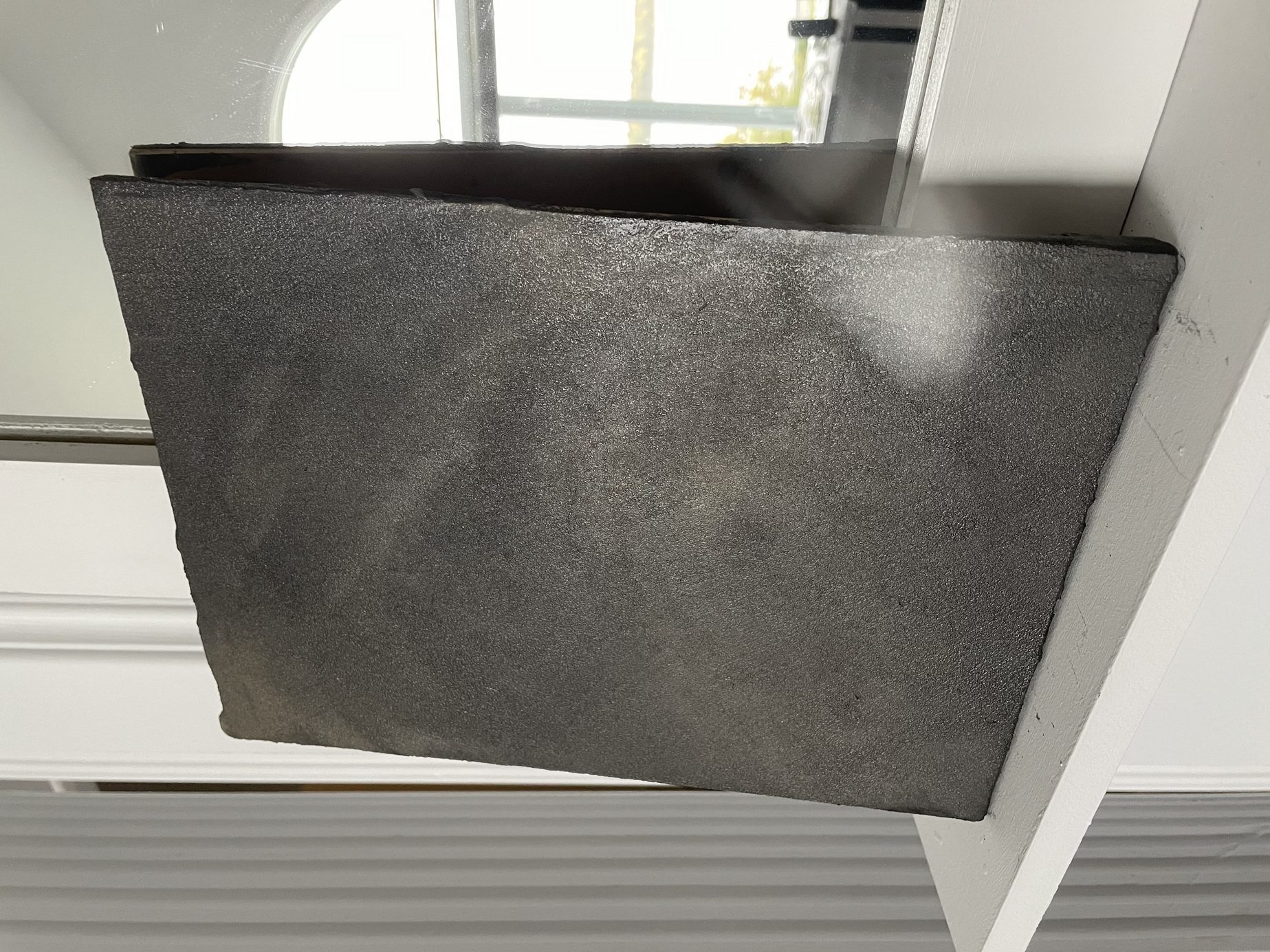
Microcement — sometimes called microcemento or thin-coat cementitious overlay — is a polymer-modified cement compound. It goes on in thin layers over existing substrates, bonds without mechanical fasteners, and cures to a hard, dense finish. The texture is matte to satin, with a fine aggregate that gives it a slight granular quality under direct light.
[PHOTO:1knT0P8zbPCzYgyHC09FEl8ZmGotQaco]
The real advantage of microcement over venetian plaster is versatility of application. It can cover floors, walls, countertops, shower enclosures, and bathtub surrounds continuously — no grout lines, no transitions, one monolithic surface from floor to ceiling to bench seat. That seamlessness is genuinely dramatic in a small condo bathroom.
[PHOTO:1YPMNMP6sT30u2lqeHYppffUkwrBeHF5j]
Microcement also handles moisture exposure better than lime-based finishes, provided it’s properly sealed. A marmorino accent wall in a dry living room is fine for decades. That same material in a steam shower without a specialized sealant system is a problem. Microcement with a quality sealer is rated for wet areas.
The aesthetic reads differently too. Microcement has a quiet industrial authority. Warm grey tones, muted ochres, deep charcoals — it suits the vocabulary of exposed concrete, matte black fixtures, and engineered oak flooring that dominates the Toronto condo market right now. Venetian plaster can do warm and cool, but microcement leans naturally into that restrained contemporary palette.
The five real deciding factors: moisture, budget, texture hunger, timeline, and touch
Touch. Go back to that sample board. Run your hand across both. This sounds subjective because it is. But I’ve seen clients who were convinced by photographs that they wanted microcement reach for the marmorino sample and not let go. The reverse happens too. You will know.
Moisture. If the accent wall is in a bathroom, kitchen backsplash zone, or anywhere near a steam shower, microcement with proper sealing is the more forgiving call. Venetian plaster requires specialist sealers in wet areas and ongoing maintenance awareness. In a dry living room or bedroom, both perform excellently.
Texture hunger. Some clients want a surface with presence — something that rewards getting close, that looks different from ten feet than from two feet. That’s venetian plaster. Some clients want a surface that reads as a background — immaculate, calm, setting off furniture and art rather than competing with it. That’s often microcement. Neither is a compromise; they’re different intentions.
Timeline. Both materials require multiple coats and drying time between them. Neither can be rushed without defects. Microcement typically cures to a protective-seal-ready state faster than a multi-coat marmorino burnished finish. If you’re on a tight occupancy schedule, this matters.
Budget. Both materials are premium finishes requiring skilled labour. Neither is cheap. That said, the cost difference between them on a single accent wall in a Toronto condo is less dramatic than people expect — the labour intensity is comparable. Where microcement can pull ahead cost-wise is if you’re covering floors and walls in one scope, using the same material throughout. Where venetian plaster can make more sense economically is a single statement wall where the material’s visual depth justifies the specificity of the craft.
Which finish wins in the most common condo scenarios
Living room feature wall, floor-to-ceiling, south-facing windows: Venetian plaster. The changing light throughout the day is exactly what marmorino was designed for. The finish will look like three different materials between 8am and 8pm, and all three will be beautiful.
Primary bathroom, full enclosure including shower: Microcement. The seamlessness and moisture tolerance are decisive here. One material, no grout, no visual interruption.
Bedroom headboard wall: Either, honestly. Venetian plaster brings warmth and intimacy — the shifting-light effect reads especially well in a room with low, directional lighting. Microcement in a deep muted tone can be genuinely arresting. This is where physical samples in your actual bedroom under your actual bedside lamp matters most.
Kitchen backsplash: Microcement, with appropriate sealing. The splatter and humidity exposure make lime-based finishes a harder maintenance commitment.
Entryway in a narrow condo corridor: Venetian plaster. The depth tricks the eye into reading the space as wider and more substantial. A reflective marmorino in a warm off-white can make a corridor feel like an arrival rather than a transition.
Home office accent wall behind a desk: Either. Consider the direction of your monitor light and task lighting — microcement’s matte surface will cause less screen glare if you’re filming video calls or sensitive to reflection.
How my team approaches the first site visit differently for each material
When we show up for a site visit on a venetian plaster enquiry, the first thing I’m doing is reading the light. What direction does it come from? Is it hard, direct sun or soft diffused northern light? Where does the shadow fall at 6pm? Marmorino is a light-reactive material, and the decisions we make about trowel direction, burnish level, and aggregate size all come downstream from that light study. I’ll ask to see the space at different times of day if I can.
For a microcement enquiry, I’m looking at the substrate first. Microcement is only as stable as what it’s bonded to. Condo walls in older Toronto high-rises can have movement, settlement cracks, or legacy coatings that need addressing before we apply anything. I’m also looking at the full scope — are we talking about one wall, or does the client actually want floor, wall, and bathroom continuous? Because if the latter, the whole project logic changes.
Both site visits end the same way: I bring the sample board, we find the best light source in the unit, and we put physical samples in front of the client. Not photos of samples. The actual slabs, in their space, under their lighting conditions. This is where the Instagram-informed decision either confirms or dissolves. More often than not, standing there with samples in hand, the right choice becomes obvious.
I’ve worked with clients who came in absolutely certain they wanted venetian plaster — had the colour picked, had the reference images saved — and the moment they held a microcement sample up to their south-facing window, they changed their minds. The opposite happens just as often. The point is that certainty before that moment is usually premature.
The one mistake people make after they’ve already decided
They don’t tell their trades.
I get called in after the fact more often than I’d like. The client has chosen a venetian plaster feature wall. Beautiful. But the electrician who came through before us mounted the TV bracket and ran the conduit without knowing the finish plan, and now there are anchor points and patched repairs in the main panel area that are going to read under a burnished surface. Or the painter has already put two coats of latex on the wall to prep it — which is not the right substrate preparation for lime-based plasters.
Microcement has its own version of this problem. The flooring contractor installed the engineered hardwood up to the base of the wall without leaving the transition detail we needed. Now we have a material boundary that’s going to look awkward instead of seamless.
The fix for both is simple: once you’ve decided on the finish, tell every other trade before they start their scope. The finish material governs prep decisions, substrate requirements, and sequencing. It’s not a final step — it’s a constraint that runs through the whole project.
Decide early. Tell everyone. Then let the material do what it was made to do.
If you’re in the Toronto area and you’re in that in-between moment — finish selected in theory, still not sure in practice — call me. 647-450-1512. info@designerwallfinishes.com. Bring your screenshots. I’ll bring the samples.