
Limewash on a bedroom feature wall gives you a soft, layered, organic finish — chalky and cloudy when dry, with subtle tonal variation that shifts depending on the light. It reads as aged and textured without being rough or rustic. If you’re in Toronto and thinking about a statement wall behind the bed, here’s everything you need to know before you commit.
What does limewash actually look like on a bedroom wall?
Limewash dries to a matte, almost mineral finish — think weathered Italian plaster, not flat latex paint. The depth comes from multiple thin coats applied in slightly different directions, which creates natural variation in tone and opacity. Some areas absorb more pigment, others less. That’s the look.
It’s not uniform, and that’s the point. A limewashed feature wall behind a bed doesn’t compete with furniture — it recedes and breathes. In a low-light bedroom, the tonal variation reads as warmth rather than pattern. Warmer tones — ochres, taupes, terracottas — hold their richness even in dim lighting. Cooler greys or whites can go a bit flat in a north-facing room, so that’s worth considering when you’re choosing colour.
What limewash doesn’t give you is sheen or polish. If you want depth with reflectivity — the kind of surface that seems to glow — you’re describing something closer to Venetian plaster, not limewash. They’re related materials but different finishes. More on that below.
Can you limewash over drywall in a Toronto home?
Yes, you can limewash over drywall — but the prep work matters enormously. Standard drywall is a fine substrate as long as it’s properly primed and in good condition. You need a high-quality, breathable primer that allows the lime to bond correctly. Skip that step or use the wrong primer and the limewash can peel, streak, or absorb unevenly.
Older Toronto homes sometimes have plaster walls rather than drywall, especially in the Annex, Rosedale, and older neighbourhoods east and west of downtown. Lime actually bonds beautifully to original plaster. The surface does need to be stable — no soft spots, no crumbling — but if it’s solid, it’s a great substrate.
The other thing worth checking in Toronto homes specifically is humidity management. Bedrooms generally don’t see the moisture swings that kitchens and bathrooms do, which makes them an ideal room for limewash. Lime is breathable and handles minor humidity variation well. I’d always rather put limewash in a bedroom than in a steam shower — the bedroom is easier to control.
How much does a limewash feature wall cost in Toronto?
I’m not going to throw out a per-square-foot number here, because it wouldn’t be accurate or useful. Cost depends on wall condition, prep required, number of coats, colour mixing, and the specific product and technique used. A single accent wall is a different scope than a full room.
What I can tell you is that limewash sits at the more accessible end of the decorative plaster spectrum. It’s less labour-intensive than marmorino or grassello di calce, which require multi-stage burnishing and trowel work. That said, it’s not a DIY-friendly finish if you care about the result — application technique directly affects the final look, and an uneven hand shows.
The right approach is a consultation. I bring samples, we look at the wall in your actual light, we discuss prep, and we give you a proper number based on what the job actually involves. That’s how pricing gets done at our level of finish — not off a calculator.
Limewash vs. Venetian plaster for a bedroom: which should you choose?
Limewash gives you a matte, soft, organic surface. Venetian plaster — stucco veneziano, or marmorino depending on the aggregate — gives you depth, translucency, and a polished or satin finish. They’re both lime-based, but they behave very differently on the wall and in a room.
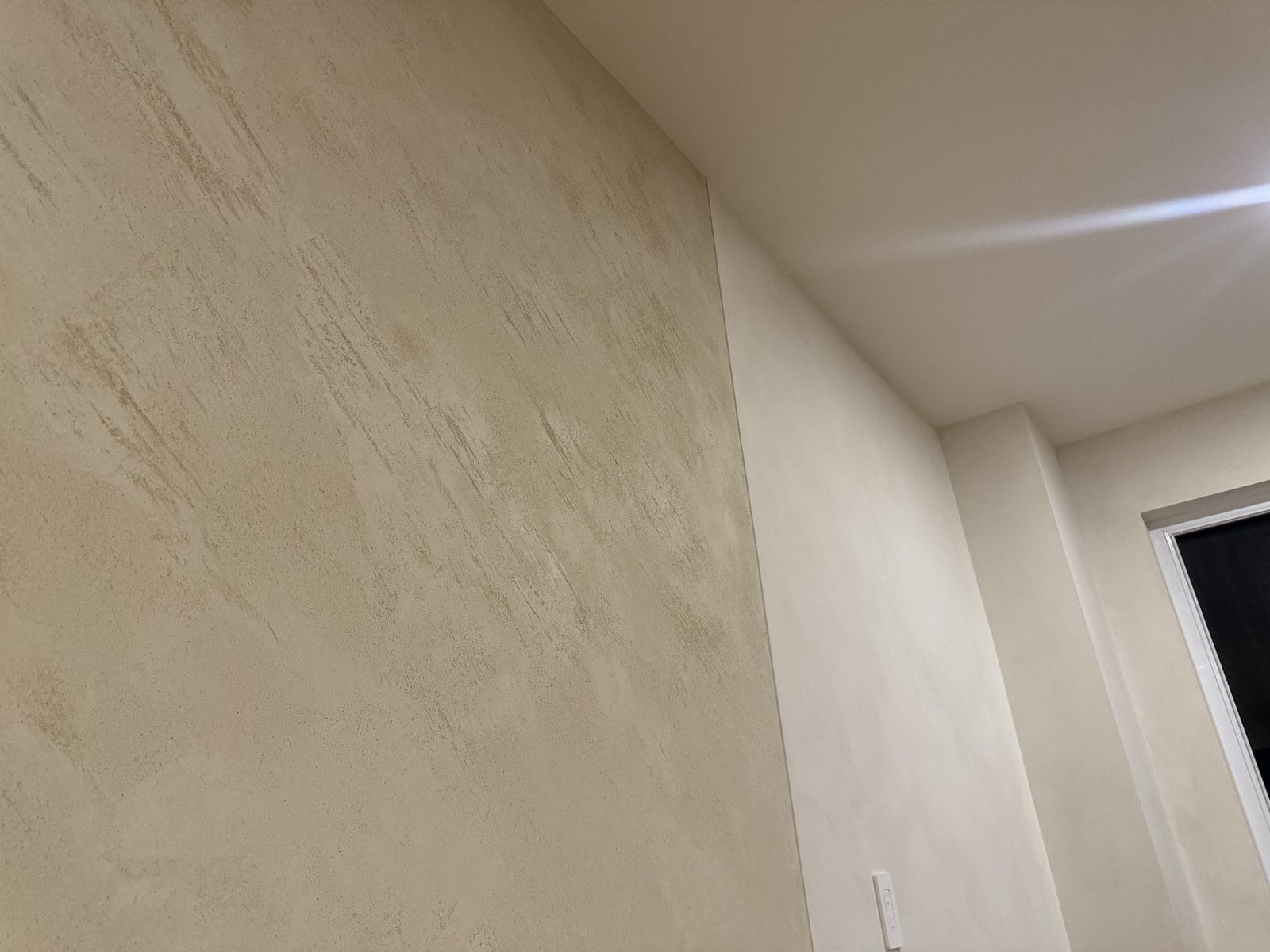
Here’s how to think about the choice for a bedroom:
– Limewash suits modern, organic, and Japandi-influenced interiors. It pairs well with linen, raw wood, matte black hardware. It doesn’t compete. In a room with a lot of texture already — a bouclé headboard, a jute rug — limewash sits back and lets those elements breathe.
– Venetian plaster suits interiors where the wall is meant to be a focal point. The burnished surface catches and moves light. In a dark or north-facing bedroom, a polished grassello di calce wall can actually make the space feel richer and more luminous. It reads as more formal, more architectural.
The concern I often hear is that limewash will feel “too rustic” against contemporary furniture. In my experience, that worry is usually about colour choice, not the finish itself. A limewash in a cool greige or a deep charcoal reads as very current. The rustic association comes from warm, heavily textured applications — that’s a style choice, not an inherent property of the material.
If you love the organic, aged look but want something that holds up with a cleaner, more refined aesthetic, I’d usually push toward a lighter-touch limewash application with a more restrained colour. Or I’d look at a spatolato finish, which bridges the gap between limewash and full polished plaster. The right answer depends on the specific room, the furniture, and the light — which is why I always want to see the space before recommending anything definitively.
Prep checklist before limewashing your bedroom wall
The finish is only as good as the prep beneath it. Here’s what needs to happen before the first coat goes on:
– Patch all damage. Cracks, nail pops, dents — any imperfection will telegraph through limewash, especially in raking light. Fill, sand flush, and feather the edges. – Sand the wall smooth. You don’t want high spots or ridges. Limewash is thin and doesn’t self-level the way thicker plasters do. – Clean the surface. Dust, grease, and residue all affect adhesion. Wipe the wall down and let it dry completely. – Apply the right primer. Not every primer is compatible with lime-based products. You need a breathable, mineral-compatible primer — not a standard latex sealer. – Protect everything adjacent. Trim, ceilings, floors. Limewash splashes and the pigment can stain. Proper masking takes time but saves you hours of cleanup. – Check the room humidity. Don’t apply in extreme cold or high humidity. The product needs consistent conditions to cure properly.
If the wall has been painted with a glossy or semi-gloss paint, you’ll need to degloss it first — either by sanding or using a chemical deglosser. Limewash won’t bond properly to a shiny surface.
How long does limewash last — and can you repaint over it later?
Limewash is genuinely durable when it’s applied correctly and the surface was prepped properly. A sealed application on an interior bedroom wall can last well over a decade without any intervention. It’s a breathable, mineral finish — it doesn’t trap moisture the way some synthetic coatings do, and it doesn’t yellow or crack the way standard paint can.
That said, limewash is softer than polished Venetian plaster. In a bedroom where the wall isn’t going to get scrubbed or knocked around, that’s a non-issue. In a hallway or a kids’ room, I’d think harder about the finish choice.
Touch-ups are relatively straightforward. If a section gets damaged or you want to refresh it years later, you can re-apply in the same area and blend it in. The organic variation of limewash actually makes touch-ups easier to blend than with flat paint — the irregularity is forgiving.
Can you repaint over it later? Yes. Limewash doesn’t permanently preclude other options. You’d prime it properly first, then paint over it like you would any other wall. You can also go from limewash to a more substantial plaster finish down the road — the substrate just needs to be sound.
One thing worth knowing: limewash continues to develop and patina slightly over time, especially in rooms with some humidity variation. For most people that’s a feature, not a flaw — it’s what makes aged lime surfaces in old European buildings look the way they do.
How to get started with a limewash bedroom wall in Toronto
The first step is figuring out what you actually want — and that’s harder than it sounds when you’re working from Instagram photos and paint chips under fluorescent store lighting. The way a colour looks in a showroom or on a screen is not how it’ll look on your wall at 9pm with a bedside lamp.
I always tell people to think about three things before we talk:
– What direction does the room face, and what’s the quality of natural light? – What’s already in the room — furniture finish, flooring, textiles? – Are you going for one feature wall or the full room?
That last question matters more than people think. A single limewash feature wall behind the bed is a contained project — specific, dramatic, easy to live with. A fully limewashed room is a different commitment, and not every bedroom proportionally suits it.
We serve homeowners across Toronto, Mississauga, Oakville, Vaughan, Richmond Hill, Markham, Burlington, and Brampton. Whether you’re planning a feature wall in a North York condo or a full bedroom in a Rosedale heritage home, the process starts the same way: we look at the space together, in person, with real samples.
Call me at 647-450-1512 or email info@designerwallfinishes.com. Bring your screenshots, your fabric swatches, your mood board — whatever you’ve been collecting. I’ll bring the samples. We’ll put them against your actual wall in your actual light, and you’ll know exactly what you’re getting before a single coat goes on.