
When you search “venetian plaster near me,” you’re going to get back three very different kinds of results: a big-box store selling a faux-plaster kit, a general contractor who lists decorative finishes as one of forty services, and a dedicated decorative finishes studio. Same search. Wildly different outcomes. Knowing how to tell them apart before you pick up the phone is what this post is for.
What does a ‘venetian plaster near me’ search actually get you — and what should you look for?
Most of what ranks for that search is not what you’re actually looking for. The kits at hardware stores use acrylic-based compounds with marble dust added for texture — they can look decent in photos, but they’re not lime plaster, they don’t breathe, and they don’t age the same way. A general contractor who “does Venetian plaster” alongside tile, drywall, and flooring is usually applying those same products with a trowel. A specialist studio is working with true grassello di calce or marmorino — slaked lime and crushed marble, applied in multiple hand-trowelled layers and burnished to a finish that’s literally part of the wall.
What you should actually look for when you search:
- A portfolio that shows multiple finish types — polished, matte, satin, aged — not just one look repeated
- Evidence they work with Italian materials, not domestic acrylic compounds
- A process that involves consultation before any quote
- Someone who can explain the difference between marmorino and grassello without Googling it
If a contractor can’t tell you the difference between the plaster types, or gives you a per-square-foot price in the first ten minutes, those are red flags. Real Venetian plaster work is priced per project after a proper consultation — the prep conditions, the room geometry, and the finish all affect the scope.
How much does venetian plaster cost in Toronto and the GTA?
Venetian plaster is a premium artisan finish — I won’t pretend otherwise. It costs more than paint. It costs more than wallpaper. What you’re paying for is skilled hand application, Italian materials, and a finish that will outlast pretty much everything else in the room.
I don’t publish per-square-foot rates, and I’d be skeptical of anyone who does without seeing the job first. The variables are significant:
- Surface condition (new drywall vs. existing painted walls)
- Which plaster system — marmorino, grassello, stucco veneziano
- Finish level — a matte velvet finish takes fewer passes than a deep mirror polish
- Room geometry — archways, niches, and ceiling transitions add time
What I can tell you is this: properly applied Venetian plaster that’s been sealed correctly lasts decades. It’s harder than drywall compound. It doesn’t chip the same way paint does. Calculated over the lifespan of the finish, it’s often more economical than repainting every five to seven years. That’s not a sales line — it’s just material science.
For Toronto, Mississauga, Oakville, Vaughan, Richmond Hill, Markham, Burlington, and Brampton — reach out for a consultation. That’s how the pricing conversation starts.
Can venetian plaster be applied in any room, or are some spaces off-limits?
Venetian plaster can go almost anywhere, but the approach changes depending on the environment. Lime-based plasters are naturally breathable and antimicrobial, which makes them well-suited for high-humidity spaces — provided the application and sealing are done correctly.
For bathrooms and kitchens, I’d go with a properly sealed marmorino or polished grassello. The sealing step isn’t optional in wet areas — a penetrating wax or resin sealer locks the surface against moisture penetration. Applied that way, it holds up well around sinks, showers, and backsplash zones.
Fireplaces are a strong application for Venetian plaster, particularly the surround and adjacent wall area. The lime base handles ambient heat well. I wouldn’t apply it directly inside a firebox, but on the facing and mantel wall it’s one of the best-looking options available.
Living rooms, dining rooms, hallways, and bedrooms are the most common residential applications. Accent walls work well here — you get the depth and texture of the plaster as a focal point without doing the entire square footage.
Commercial spaces — hotel lobbies, restaurant interiors, retail stores, spas — are actually where Venetian plaster earns its durability argument most clearly. Heavy foot traffic, frequent cleaning, and constant lighting scrutiny. A well-applied, properly sealed finish holds up to all of it.
The one scenario where I’d pump the brakes: exterior applications. Some lime plasters are formulated for exterior use, but standard interior marmorino or grassello is not the right tool outside. If you’re asking about an exterior wall or a covered outdoor space, the product selection and prep process are entirely different.
How do you vet a venetian plaster applicator before you hire them?
Ask four things before you commit to anyone.
One: What materials do you use? The answer should reference lime-based plasters — marmorino, grassello di calce, stucco veneziano — ideally from Italian manufacturers. If the answer is “a specialty compound from the paint store,” that’s your answer.
Two: Can I see samples in person? A serious applicator has physical samples — actual cured plaster on boards — that show different finishes and colours. Looking at photos on a phone screen tells you almost nothing about how the material actually behaves. Any contractor who can’t show you a physical sample board before starting work is not someone I’d hire.
Three: How do you handle prep? The answer should include discussion of wall condition, priming, and base coat. Venetian plaster applied over a bad substrate fails. Period. If they’re not asking about your existing wall condition before they quote, they’re skipping steps.
Four: What does your sealing process look like? For polished finishes, the encausto — the wax or resin sealing layer — is what locks in the burnish and protects the surface. If a contractor doesn’t mention sealing as a distinct step, or says “it doesn’t need it,” walk away.
Reviews matter, but portfolio depth matters more. Anyone can accumulate a handful of five-star reviews. What you want to see is range — different rooms, different finish levels, different colour palettes — over multiple projects. That range tells you whether the person applying plaster to your walls has actually solved different problems before, or just repeated one technique.
Marmorino, Grassello, Stucco Veneziano — which type of venetian plaster is right for your project?
These are the three main systems you’ll encounter from a serious applicator. Here’s how they differ in plain terms.
Marmorino is made from slaked lime and fine crushed marble. It has a slightly granular texture that gives the finish depth without the ultra-high-gloss look. Burnished lightly, it reads as satin stone. Burnished harder, it takes on a cooler, glassy quality. It’s versatile, handles colour well, and is a strong choice for both residential and commercial interiors. In bathrooms and kitchens it’s my go-to because it seals reliably and the texture variation hides minor imperfections better than a mirror polish.
Grassello di calce is pure aged lime putty — no marble aggregate. This is the more traditional material, and it’s what produces the deepest translucency and the highest-polish mirror finish. It’s also the more demanding application: thinner layers, more burnishing passes, less margin for error. For a feature wall where you want maximum visual depth and a finish that genuinely looks like polished stone, grassello is the system.
Stucco veneziano is often used as a broader term for Venetian plaster in general, but technically it refers to a lime and marble system applied in a way that emphasises movement and depth through layered colour variation. Think of it as the most expressive of the three — you’re building up translucent layers where each one shows through the next, creating a finish that shifts with the light.
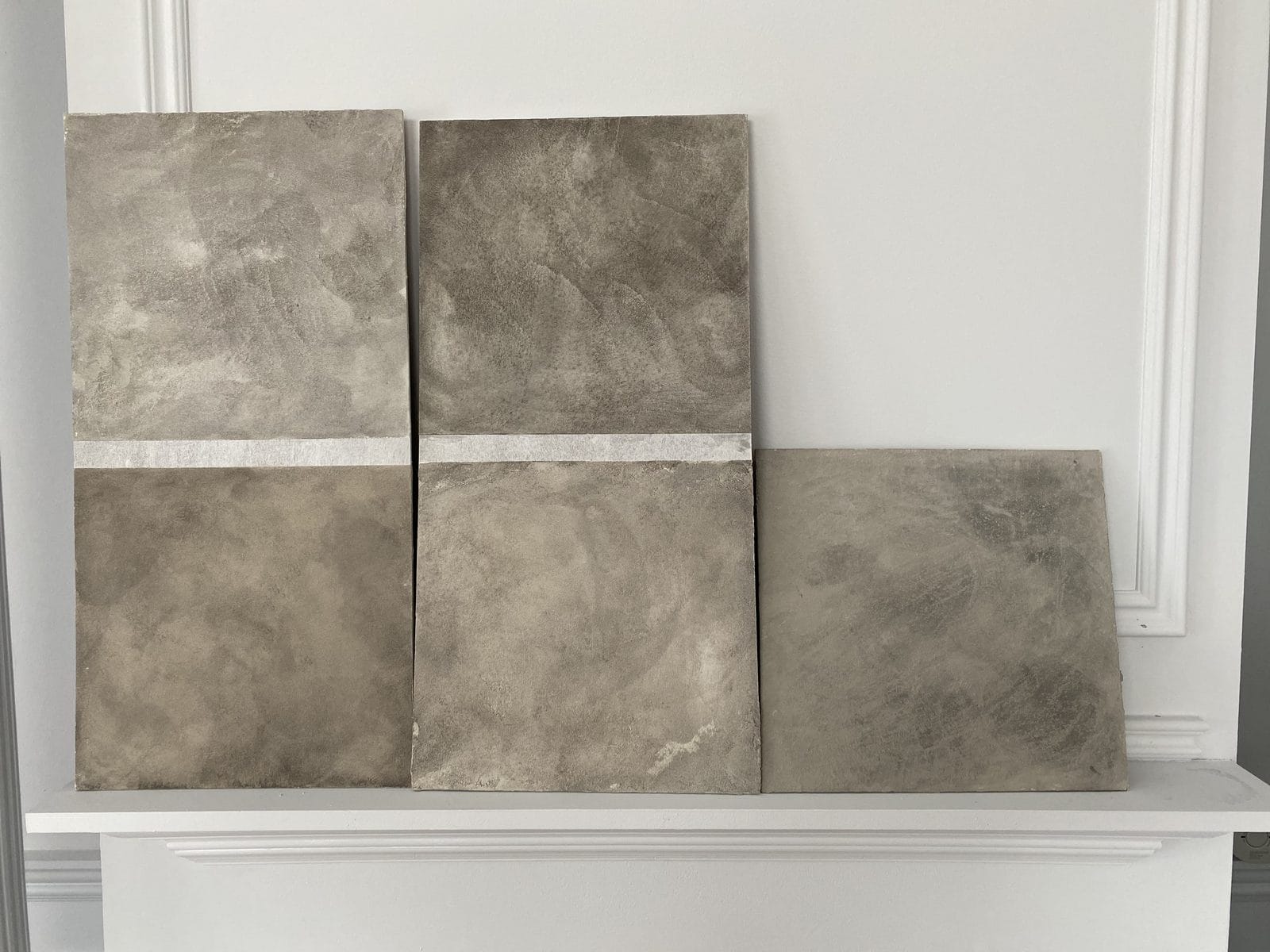
Which one is right for your project depends on the surface, the room, and the finish level you’re after. That’s exactly what a proper consultation is for — looking at samples together and working out which system fits the light conditions, the colour direction, and the practical demands of the space.
What to expect from the process: consultation to finished wall
The process has five stages, and skipping any of them shows in the final result.
Consultation and colour development. This is where the project actually starts. We look at the space, talk about the finish level, and work through colour options using physical samples. Venetian plaster colour reads completely differently on a sample board than it does in a paint chip — the depth and movement change everything — so this step takes the time it takes.
Surface preparation. The wall has to be right before any plaster goes on. That means assessing the existing surface, priming correctly for the plaster system being used, and fixing any structural issues — cracks, uneven areas, moisture damage. No amount of skill in the application layers compensates for a bad substrate.
Multi-layer hand application. Venetian plaster is applied in thin layers with a steel trowel. Each layer needs to cure before the next goes on. The number of layers depends on the system and the finish level — typically two to four coats for marmorino, more for a deep grassello polish. Each layer adds translucency and builds the overall tone.
Burnishing. This is where the finish comes alive. A steel trowel is used to compress and polish the surface, generating heat through friction and closing the pores of the lime. The level of burnishing determines the final sheen — light passes produce a satin finish, extended work produces the mirror polish that grassello is known for.
Sealing. For most applications, a final sealing step — encausto — protects the surface and locks in the polish. In wet areas, this is non-negotiable. In dry living spaces it adds longevity and makes the wall easier to clean.
The full process is hands-on and it takes time. Anyone promising fast turnaround on a polished Venetian plaster wall is cutting corners somewhere — most likely in cure time between layers or in the burnishing stage.
Prep checklist before your venetian plaster applicator arrives
There are things you can do before we show up that make the job go smoother and protect the rest of your space.
- Clear the room as much as possible. Furniture, art, and accessories should be moved away from the work area
- Remove wall plates — outlet covers, switch plates, any hardware mounted to the wall being plastered
- If there’s flooring you’re worried about, say so — we use drop protection, but knowing what’s underfoot helps
- Flag any existing wall damage you’re aware of: old cracks, water staining, areas that feel soft or hollow
- Make sure the space has reasonable temperature and ventilation — lime plaster needs stable drying conditions, not cold drafts or extreme heat
- If you have paint colours or material samples you’re working around (flooring, cabinetry, tile), have them on hand for the consultation. Venetian plaster colour is developed to fit the whole room, not in isolation
If your walls have been painted with a high-sheen or oil-based paint, flag that early. Those surfaces need specific primer treatment before plaster adhesion is reliable. Same goes for any walls that have had moisture issues — we need to confirm the problem is resolved before the plaster goes on, not discover it halfway through.
Ready to talk about your project?
Call me directly at 647-450-1512 or email info@designerwallfinishes.com. Bring your screenshots, your inspiration photos, your tile samples, whatever you’ve been collecting. I’ll bring the physical sample boards — real cured plaster in the finishes and colour directions that make sense for your space. We’ll figure out together which system fits the room, the light, and what you’re actually trying to achieve. That’s how this process works when it’s done right.